
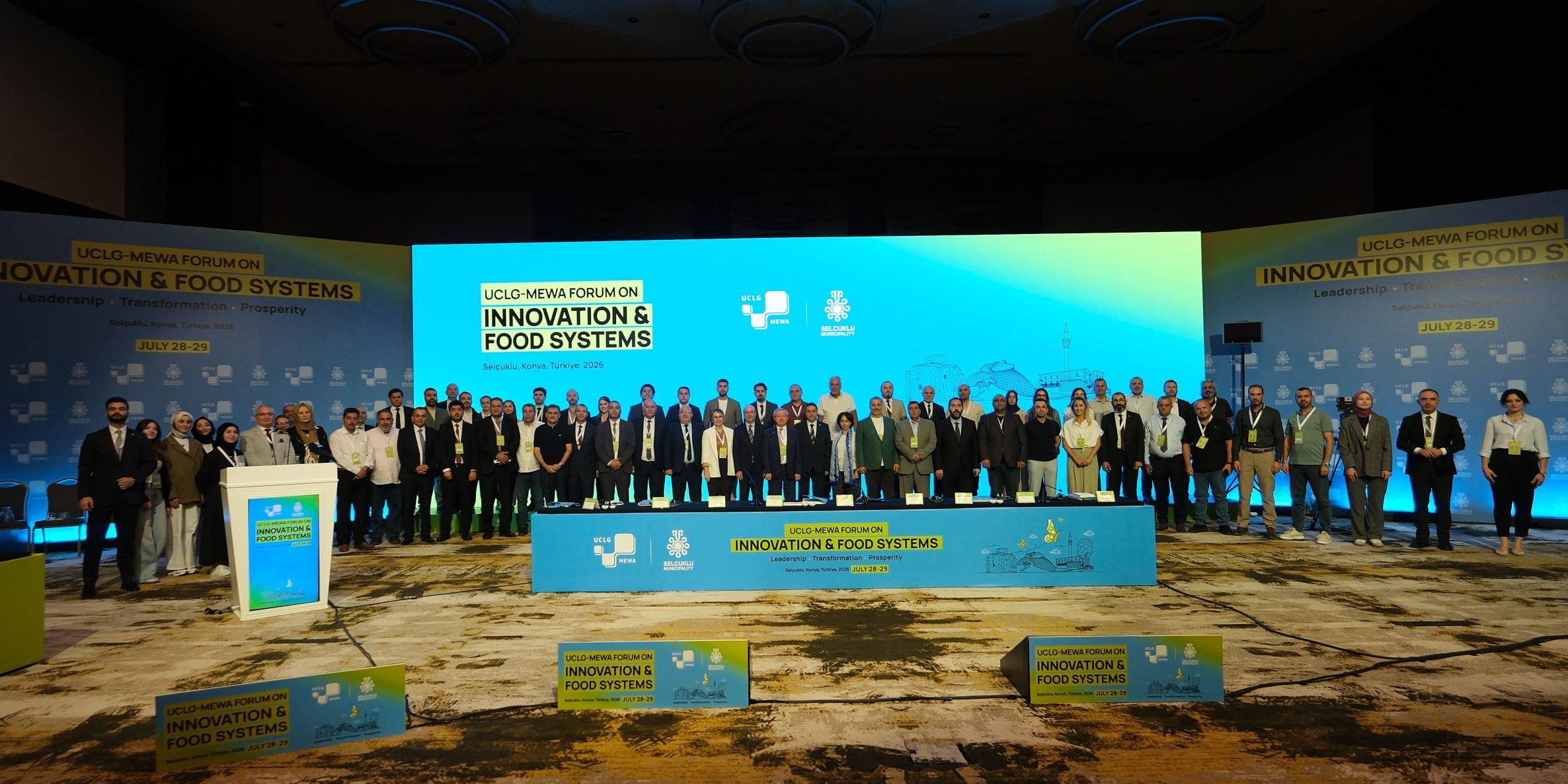
UCLG-MEWA Forum on Innovation and Food Systems brought together municipal leaders, regional delegates, international representatives, academic experts, and urban policy specialists in Selçuklu on July 28–29, 2026. Hosted by Selçuklu Municipality, the two-day event served as a comprehensive regional platform for addressing the interconnected challenges of climate change, urban food security, smart city technologies, and local economic resilience across the MEWA region.
The forum commenced with official opening remarks setting the strategic vision for the forum. Dr. Mehmet Duman, Secretary General of UCLG-MEWA, stressed that cities must act as proactive centers of transformation grounded in regional peace. Ahmet Pekyatırmacı, Mayor of Selçuklu, emphasized municipalities’ frontline role in combating climate change, while Uğur İbrahim Altay, Mayor of Konya and President of UCLG, affirmed that local achievements in smart cities and sustainable agriculture must serve as global models. Additional opening contributions from Wael Zmerly, President of the Union of Al Fayhaa Municipalities and Co-President of UCLG-MEWA; Mahmut Özçınar, Mayor of Güzelyurt, President of the Union of TRNC Municipalities, and Co-President of UCLG-MEWA; Youssef Al Jabari, Mayor of Al Khalil and President of UCLG-MEWA; and Konya Governor İbrahim Akın collectively reinforced the need for regional solidarity, purpose-driven innovation, and support for conflict-impacted municipalities.
Delivering the keynote address, Dr. Mehmet Mehdi Eker, Former Minister of Food, Agriculture, and Livestock of Türkiye, underscored that food system innovation cannot follow a generic model but must be rooted in specific geographical realities. Addressing modern urbanization, he called for a fundamental shift in how cities integrate nature, emphasizing that protecting biodiversity, safeguarding arable land, and expanding green infrastructure are essential pillars for building truly resilient, sustainable, and food-secure urban futures.
A major outcome of the event was the official launch of the UCLG-MEWA Working Group on Food and Agriculture, designed to institutionalize regional peer learning, scale up agricultural innovation, and champion climate-resilient local governance. Highlighting the strategic importance of local action, Uğur İbrahim Altay, Mayor of Konya and President of UCLG, affirmed that local governments must drive urban innovation, resilience, and human-centered development, noting that local achievements in smart city solutions and sustainable agriculture must directly benefit citizens, foster social cohesion, and serve as models for cities globally.
Dr. Mehmet Duman, Secretary General of UCLG-MEWA, emphasized that cities must act as active centers of transformation, noting that regional peace provides the essential foundation for genuine urban innovation and localized climate resilience. Co-chairing the discussions, Ahmet Pekyatırmacı, Mayor of Selçuklu and Chair of the new Working Group, highlighted the frontline role local municipalities play in combating climate change and called for practical policy frameworks that enable cities to directly benefit from shared best practices.
Building on these institutional goals, the forum hosted the UCLG-MEWA Committee on Innovation and Entrepreneurship Presidency Meeting. During this session, organizational leadership and municipal representatives reviewed key policy papers, draft activity programs, and municipal safety strategies focused on integrating smart city ecosystems, artificial intelligence, and youth engagement into local governance structures across the MEWA region.
Subsequent high-level dialogues and panel discussions brought together regional mayors, national dignitaries, and international delegates to reinforce the necessity of multilateral governance, proactive risk reduction, and natural resource protection. A central focus throughout the sessions was aligning local actions with global frameworks through stronger multilateral cooperation and international partnerships. The vital role of international organizations was highlighted by UN-Habitat, the Food and Agriculture Organization (FAO), and the Global Covenant of Mayors (GCoM), which emphasized climate finance mechanisms, circular waste management, and alignment with the SDGs. Additionally, delegates addressed severe humanitarian and economic pressures on local governance across conflict-impacted areas in the MEWA region, advocating for international solidarity and multi-stakeholder support.
A key priority established during the forum was academy–local government cooperation, demonstrating how local authorities can evolve into active innovation hubs through university-municipality partnerships, data-driven governance, and social inclusion initiatives. Academic institutions like Konya Food and Agriculture University, Ankara University, and Innopark Konya demonstrated how research directly fuels municipal precision agriculture and smart soil management. Speakers affirmed that agricultural innovation cannot rely on a generic model; it must reflect distinct geographical realities, safeguard arable land, and integrate nature directly into urban development plans.
Working alongside regional municipalities, networks, and policy bodies—including AGRICITIES, the Marmara Municipalities Union, TARPOL, and the Good Governance Center—shared field-tested municipal solutions. These implementations spanned healthy food distribution models, post-disaster rural recovery strategies, circular waste management, drought mitigation across agricultural basins, and AI-assisted public communication systems.
The technical deliberations further examined the food-water-energy nexus, basin management, climate finance accessibility, and precision agriculture, while emphasizing the vital role of engaging youth in leading future agri-food transformations. Closing reflections celebrated the forum’s shared consensus, reaffirming a collective commitment to translating local innovation and responsible resource stewardship into lasting regional cooperation across the MEWA region.
Complementing the academic and strategic sessions, delegates participated in field visits showcasing Selçuklu’s premier urban best practices in sustainability, youth development, and environmental conservation. The itinerary included site visits to the Selçuklu Sports Selection and Training Center, the Konya Tropical Butterfly Garden, and the Butterfly Valley Flower Garden, allowing participants to observe firsthand how local municipal projects effectively blend urban green spaces, social inclusion, and eco-tourism.
Event Resources & Media
- To view and download the official photo gallery from the forum, please click here.
- To access the presentations delivered by experts during the forum, please click here.
