
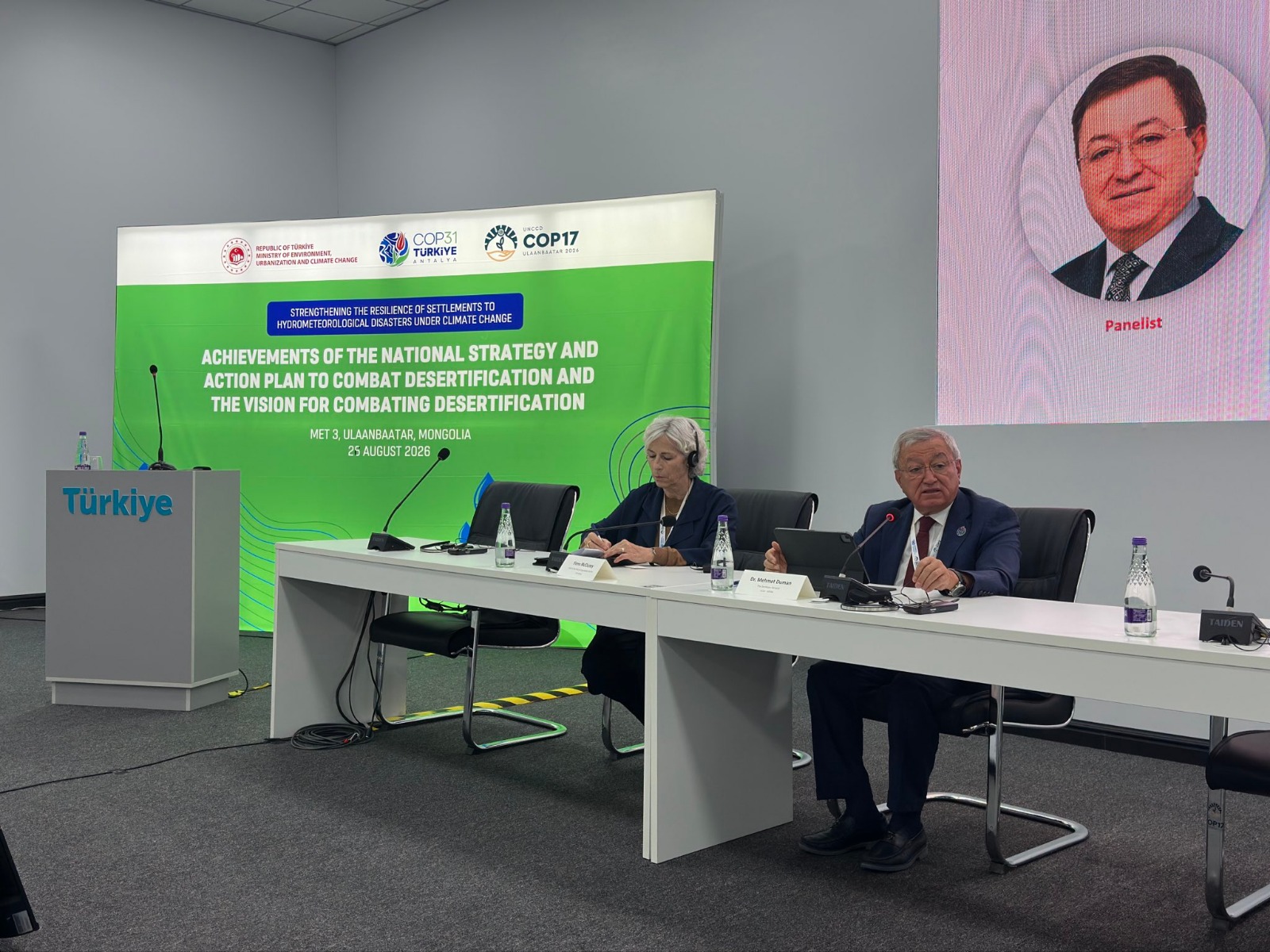
As extreme weather events, land degradation, and severe droughts continue to disrupt cities globally, local and regional governments took center stage at the 17th session of the Conference of the Parties to the United Nations Convention to Combat Desertification (UNCCD COP17), held in Ulaanbaatar, Mongolia, from August 17 to August 28, 2026. Representing the MEWA region, the United Cities and Local Governments Middle East and West Asia Section (UCLG-MEWA) actively participated in sessions aimed at strengthening municipal strategies to address climate threats, urging international bodies to empower local authorities directly.
Delivering a key address at the session “Strengthening the Resilience of Human Settlements to Hydrometeorological Disasters in the Context of Climate Change,” Dr. Mehmet Duman, UCLG-MEWA Secretary General, emphasized that infrastructure alone is insufficient to protect vulnerable populations, stating that cities cannot build resilience to hydrometeorological disasters through infrastructure alone, as it requires local knowledge, early warning systems, and strong multilevel governance. Dr. Duman stressed that local and regional governments sit on the absolute frontlines of climate disasters and must be equipped with the necessary policy tools, legal authority, and financial resources to act swiftly against worsening flash floods, prolonged droughts, and extreme weather events across the MEWA region, while reaffirming UCLG-MEWA’s commitment to strengthening regional cooperation and disaster risk reduction.
The discussion surrounding climate resilience expanded to regional connectivity during the panel “From Flows to Action: Governing Urban-Rural Linkages for Land and People,” co-led by UN-Habitat alongside partners including Ambition Loop, ICLEI, and UCLG, where Mayor of Terme, Şenol Kul, highlighted the critical reliance of cities on surrounding rural ecosystems by stating that a city cut off from its rural hinterland cannot be sustainable. Mayor Kul explained how Terme’s local development strategies prioritize active urban-rural linkages, ensuring that water and land management policies support both urban centers and agricultural surroundings simultaneously.
In a parallel session titled “Local Government Strategies to Address Climate Change Risks,” delegates explored actionable steps to combat land degradation, landslides, and flood risks, bringing together Assoc. Prof. Dr. Serdar Koyuncu, Head of the Climate Change and Zero Waste Department at Konya Metropolitan Municipality, Sinan Sineoğlu, General Manager of Gaziantep Water and Sewerage Administration, Şenol Kul, Mayor of Terme, and Yehia Ibrahim, UCLG-MEWA General Coordinator. The speakers shared local experiences while underscoring that modern municipal planning, climate investments, and infrastructure must directly integrate scientific data and national decision-support mechanisms, emphasizing that building climate-resilient and sustainable cities requires the integrated management of water, land, natural ecosystems, and urban development supported by strong cooperation among local governments, national institutions, city networks, and international partners.
